You're Not Building a Ford: The Truth About Homeschool Socialization
Every homeschooling parent knows the question before it's asked.
Someone tilts their head. The pause stretches just a little too long. And then it comes.
"But what about socialization?"
After more than two decades of homeschooling, I've heard every version of it. The polite version from well-meaning strangers. The pointed version from family members who weren't sure I knew what I was doing. And sometimes the hostile version from people deeply invested in a decision that wasn't theirs to make.
I've doubted myself because of it. Cried over it — sometimes from the anger of being challenged on a decision I knew was right, and sometimes from the fear that I would fail my children anyway.
And eventually, I watched it answer itself.
Here's what I've learned.


The Question Behind the Question
When someone asks about socialization, they're rarely asking one thing. They're asking several things at once.
Are they asking whether your child will have friends? Whether or not they can hold a conversation with an adult? Whether they'll survive college, a job interview, or a difficult coworker?
Are they asking if you are sheltering them from reality? Or will they be able to handle people who believe differently from them?
These are different concerns. They deserve different answers.
What they're usually not asking — though some critics do get here — is the deeper philosophical question: whether removing a child from a peer-dominated institution damages their ability to participate in a diverse society. That argument exists. It's worth knowing about.
But it's not what most people mean when they ask the question at Thanksgiving.
Start with what's actually being asked. Then go deeper if the conversation calls for it.

"Homeschooled Kids Are Weird"
Let's start there. Because that's usually what people actually mean.
My kids are weird — and I mean that in the best possible way.
They are comfortable talking to people from all age groups — authority figures, homeless people, and people with obvious disabilities. They are confident enough to be completely silly with their friends in public and to say no thank you when offered something that makes them uncomfortable.
They are kind enough to stop and help the child who can't keep up on the playground and the elderly woman who dropped her groceries in the parking lot.
That is what their weird looks like.
Most of them have a confidence in themselves that I have never personally experienced. I spent 7th grade homeschooled and asked to go back for 8th, convinced that being one of the older students would be different. It wasn't. After six or seven weeks I begged to come home.
I knew what I was leaving and why.
I've watched one of my daughters being completely ridiculous with a group of friends and thought, does nothing embarrass her?
I wish I was that kind of weird.
Because here's the truth I've had to sit with: I care what people think of me — my family, my friends, my employer, and honestly even the driver behind me. That self-consciousness has held me back from more things than I can count.
The comments I hear most often about my kids — from senior citizens, festival vendors, Sunday school teachers, karate instructors, business executives, and complete strangers — are things like "your kids are so confident," "so well-spoken," "so respectful." Hardworking. Deep-thinking. Compassionate.
These aren't old memories. They are current, real-time observations from people who have no reason to flatter me.
Weird, maybe. Isolated, no.

What the Research Actually Shows
The socialization concern has been studied for decades, and the findings keep pointing in the same direction.
Eighty-seven percent of peer-reviewed studies on social, emotional, and psychological development show homeschooled students consistently score as well or better than their conventionally schooled peers (Ray, Journal of School Choice, 2017).
A large government study using the National Survey of Children's Health found no significant differences in social competencies or behavior problems between homeschooled and publicly schooled children (Bartholet et al., Home School Researcher, 2020).
Long-term homeschoolers also report better mental health outcomes — the lowest depression and anxiety scores and the highest life satisfaction of all educational groups studied (Cheng & Watson, Cardus Education Survey, 2025).
And it carries into adulthood. Homeschool graduates volunteer at higher rates than the general population and show up as more civically engaged in their communities (Seiver & Pope, Home School Researcher, 2022).
Most studies rely partly on volunteer samples, which likely skews toward more engaged families, and homeschooling outcomes vary widely. But the overall research does not support the socialization crisis narrative — it contradicts it.
The Assembly Line Problem
Modern schooling groups children by birth year and moves them through a standardized system in batches. This model was built for efficiency at scale, not necessarily as the gold standard for human development.
The socialization question assumes the school model is the baseline. It isn't. It's a relatively recent invention built for a specific purpose.
Every day you are raising your child, you are making decisions that will sculpt the adult they are becoming. You are not building a Ford rolling off an assembly line identical to the one before it.
You are raising a human being with a unique spirit, a specific personality, and gifts that no standardized system was designed to find.
Keep that end in mind and the path gets a lot clearer.

What Socialization Actually Looks Like
Homeschooled children are not sitting alone in living rooms staring at workbooks. That image is outdated, and the research reflects it.
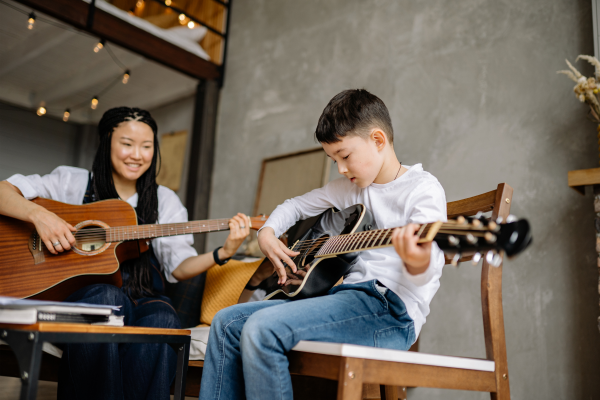
Studies document consistent involvement in co-ops, scouting programs, 4-H, sports leagues, church ministries, community volunteer work, and dual enrollment college courses (Hamlin, Peabody Journal of Education, 2019). That list isn't exhaustive.
What strikes me after two decades is this: the social world a homeschooled child moves through is often more varied in age and experience than a traditional classroom ever offers.
A child who spends Tuesday afternoon at a food bank, Wednesday evening at Bible quizzing, and Saturday morning at a karate class is navigating real relationships across a wide range of ages and backgrounds. That takes skill. It builds skill.
The difference between that and school hallway interaction is intentionality. Homeschool socialization doesn't happen by default. It has to be chosen and pursued.
But it also means the social experiences your child accumulates are ones you helped select — not ones assigned by zip code and birth year.
Kids who grow up moving between co-ops, church communities, volunteer settings, and family relationships tend to be unusually comfortable with people of all ages. They don't perform for peers. They just talk to people.
That is a skill that serves them for the rest of their lives.

The Peer Pressure Question
One of the most common objections I hear is that homeschooled children aren't prepared for peer pressure — that by avoiding it, they never learn to handle it.
It's worth flipping that around.
The number one reason parents choose homeschooling, according to a 2016 survey of over 51,000 families by the National Center for Education Statistics, is concern about the school environment — safety, drugs, and negative peer pressure. Twice as many parents cited that as their primary reason as cited dissatisfaction with academic instruction.
These parents aren't running from socialization. They're running from a specific kind of it.
Peer pressure doesn't disappear in adulthood. It shows up in workplaces, friend groups, and social circles in different forms.
A child who grows up knowing who they are — their values, their interests, their faith — is better equipped to navigate pressure than one who formed their identity primarily through survival in a peer-dominated environment.
Adults who were homeschooled report stronger personal values alignment and are more civically engaged than their publicly schooled peers (Cheng, Journal of School Choice, 2014).

"But What About Unsupportive Family?"
This one doesn't show up in research papers. But it's real, and it's one of the hardest parts.
Family members who question your decision — sometimes loudly, sometimes persistently — can do more damage to your confidence than any critic on the internet.
Because you love them. Because their opinion matters. Because they know you well enough to find the doubt you're already carrying.
I have been questioned by family, pressured to put my kids in school, and watched my husband field concerns from coworkers that came home as questions for me.
The most hostile critic my family ever faced came back years later asking my husband how to get started homeschooling his own children. He didn't lead with an apology. He led with what he'd observed.
I don't tell that story to score points. I tell it because it illustrates something true: the socialization question usually answers itself over time.
Not through debate. Through watching what your children become.
What the Other Side of Homeschooling Looks Like
I have homeschooled children who are now adults making their own way in the world. They are not all the same. They did not all take the same path.
That was never the point.
One took a gap year to build savings and help run a camp for underprivileged children. One completed community college. One graduated summa cum laude. One left college when they realized they could enter their chosen career with far less debt than their current path was building. One switched to online college and landed a management position before graduation.
Between them: a worship leader, a part-time children's pastor who also serves as a full-time director of operations, a social media and events manager, and a gym manager.
One worked through the challenges of community college and has held steady employment for over a year — which is its own kind of victory, and one I am deeply proud of.
These are not children who struggled to function in the world they stepped into. They are adults who found their footing on their own terms — because they were never handed a predetermined track and told to follow it.
The Legitimate Concerns
Intellectual honesty requires saying this plainly.
There are homeschool families where children are genuinely isolated. There are parents who use homeschooling as a shield rather than a tool — some out of fear, some out of neglect, and in rare and serious cases, some to hide abuse.
That happens. It is wrong. It is not representative, but it is real, and it deserves to be named.
There are also children in traditional schools who are isolated, underprepared, and unseen.
The building does not determine the outcome. The intention and engagement of the parent does. Well-rounded, confident, deeply educated children come out of public schools and homeschools alike. So do struggling, overlooked, and underprepared ones.
If you are homeschooling with intention — keeping your children connected to people, to community, to real work and real relationships — the socialization concern does not apply to you the way critics assume.
If someone is isolating their children and calling it education, that concern is as valid as it is for the child sitting in a classroom who is withdrawn and unwilling to talk about their home life.
The problem was never the building. It was always the level of engagement inside it.

For the Parent Still on the Fence
If socialization is the thing holding you back, here is the practical answer.
Join a co-op. Get active in a church with a thriving children's and youth program. Sign up for a sport. Go to the playground when other kids are there.
Volunteer somewhere regularly. Let your kids work alongside adults and serve people who need something.
None of that requires a school building.
What it requires is a parent who stays engaged — who keeps their children connected to friends, family, community, and the kind of real-world experiences that actually build the adults they are becoming.
You are not raising a child to be a child. Every day you are raising your child, you are making decisions that will sculpt the adult they are becoming.
That perspective changes everything.