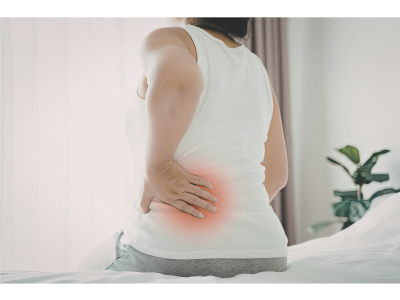
I wake up and take inventory. Not because I want to — because my body has trained me to. Pain and stiffness from inflammation start before my feet hit the floor.
When Your Body Turns Against Itself: Inflammation, Food, and the Long Road to Relief
Disclaimer: This article is educational and based on peer-reviewed research. I am not a medical professional. Please work closely with your doctor before making any changes to your health routine.
It Starts Before My Feet Hit the Floor
Doctors will tell you that inflammatory conditions come with company — and in my experience, they're right. If you have one, there's a good chance others are already present or on their way.
I was diagnosed with juvenile arthritis as a kid. It quieted down through my teens and most of my thirties — I thought I'd outgrown it. Then my early forties arrived, and it came back with a lot of company. Over the years I've also come to struggle with hidradenitis suppurativa (a painful, recurring inflammatory skin condition), PCOS (a hormonal and inflammatory disorder), endometriosis (chronic inflammation of tissue outside the uterus), and gout (uric acid crystals that form in the joints). My daughter with psoriatic arthritis (joint inflammation linked to psoriasis) also has ulcerative colitis (chronic inflammation of the colon). These conditions share the same root — a body that has lost its ability to regulate its own inflammatory response — and they cluster because of it.
My daughter with Crohn's disease was diagnosed at eleven years old. I started this research for her. The science has come a long way since I began, and I resumed that research again when my own symptoms became impossible to ignore. I'm here to share what I found.
If You Have One, You Probably Have More
So What Is Actually Going On?
Inflammation gets a bad reputation, but it's supposed to be there. When you get a cut or catch a virus, inflammation is what sends your immune system to the scene — the swelling, the redness, the heat. That's healing. The problem starts when the alarm never shuts off.
In chronic inflammatory conditions, the body keeps producing cytokines and prostaglandins even when there's nothing to fight. That constant low-level activation wears down joints, skin, gut lining, and other tissues over time. It's the same underlying process whether you're dealing with HS, arthritis, gout, psoriasis, Crohn's, or ulcerative colitis.
It's also behind PCOS and endometriosis — which weren't always thought of that way. Researchers now classify endometriosis as a chronic, systemic inflammatory disease, one that sends inflammatory signals throughout the entire body rather than staying localized to the pelvis.¹
What you eat every single day either adds fuel to that fire or helps put it out — and the research keeps confirming it.
The Compounds That Help — and Where to Find Them
Plants contain compounds that interact directly with the body's inflammatory pathways. You don't need to memorize the science, but knowing what to look for helps you find it. Three compounds show up most consistently in the research: quercetin, anthocyanins, and glucosinolates.
Glucosinolates are found in the brassica family — broccoli, cauliflower, cabbage, radish, arugula. When you chew these foods, an enzyme in the plant converts glucosinolates into sulforaphane, which flips a switch in your cells that activates your body's own anti-inflammatory defenses.⁵
Good food sources: raw or lightly steamed broccoli, broccoli sprouts, cabbage, radish, mustard greens, and arugula. High heat destroys the enzyme needed for conversion, so raw or lightly prepared is best.
Glucosinolates
Anthocyanins give red, blue, and purple foods their color — and they're powerful anti-inflammatories. For gout specifically, they block the enzyme that produces uric acid, the substance that crystallizes in joints and causes those sudden, brutal flares.³ One study of gout patients found a 50% reduction in flare frequency with consistent anthocyanin intake.⁴
Good food sources: tart cherries and tart cherry juice concentrate, blueberries, blackberries, red grapes, pomegranate, red cabbage, and purple sweet potato. Tart cherry juice has the most gout-specific research behind it.
For psoriasis and psoriatic arthritis, anthocyanins also suppress the specific inflammatory signals that drive skin lesion formation and joint damage.
Anthocyanins
Quercetin blocks the chemical signals your body uses to start and sustain inflammation — working along the same pathways as many common anti-inflammatory medications. It also acts as an antioxidant, neutralizing the free radicals that chronic inflammation generates.²
Good food sources: red onions, capers, apples, kale, broccoli, arugula, and radishes. The darker and more colorful the produce, the more quercetin it tends to contain.
Quercetin

What About Supplements?
All three are available in capsule form, and they can help. But here's what the research says about absorption:
Standard quercetin powder absorbs poorly — often less than 10% of what's on the label reaches your bloodstream. Formulations using lecithin (look for 'quercetin phytosome') absorb considerably better. Taking it with a meal that has some fat helps too.⁶
Anthocyanin capsules break down quickly outside their natural food environment. You'll get more from tart cherry juice, whole berries, or red cabbage than from most capsule forms.
Sulforaphane supplements are the most complicated. Most contain only the precursor compound without the enzyme needed to activate it. Without that enzyme, your gut bacteria handle the conversion — and how well that conversion happens varies widely between individuals. The most effective options include both the precursor and the active enzyme and need to be refrigerated.⁷
Whole food sources consistently outperform supplements — not because supplements don't work, but because food comes packaged with everything your body needs to actually use these compounds.
Making It Practical
The goal is daily exposure to these compounds across a variety of foods. A few things worth knowing:
Vitamins A, E, and K are fat-soluble — your body can't absorb them without fat present. Dress your salads with olive oil, add avocado, or pair these greens with a meal that has some fat in it.
Chewing thoroughly matters more than most people realize. Research shows that chewing breaks down plant cell walls and releases significantly more phytonutrients than swallowing quickly. Chew each bite until the food fully breaks down — soft lettuces and microgreens won't need much, but denser vegetables deserve more time.⁸
I get a lot of these compounds through microgreens. They're harvested young — before the plant's energy disperses into full growth — and the nutrient concentration at that early stage is significantly higher than in mature vegetables. A small amount added to a meal delivers a meaningful dose of quercetin, anthocyanins, and glucosinolates without a lot of preparation. Tart cherries, red cabbage, and broccoli sprouts will get you there, too — the form matters less than making it a daily habit.
Food is not a cure. Tart cherries and broccoli are not going to stop an HS flare or end a gout attack. What daily polyphenol-rich eating can do is reduce the overall inflammatory burden in your body over time — and that reduction shows up in blood tests, in flare frequency, in how severe flares are when they come. Clinical trials measuring inflammatory markers and pain scores back this up.
Every percentage point of reduction matters when you're struggling. It might not be a cure — but it might be a morning where getting dressed doesn't make your eyes water. Some days, that's a victory.
I started this research for a child in pain. I resumed it for myself. I'm sharing it because I spent years feeling like no one was talking about these conditions in a factual, understandable way. If that's where you are — keep reading. There's more to know, and it's worth knowing.
-Jennifer
What This Can — and Can't — Do
Disclaimer: This article is educational and based on peer-reviewed research. I am not a medical professional. Please work closely with your doctor before making any changes to your health routine.
• Join the email list for new articles, farm updates, and practical tools for using food to support your health.
Stay Connected
1. MDPI — Endometriosis as a Systemic and Complex Disease (2026)
2. ScienceDirect — Anti-inflammatory potential of quercetin: From chemistry to nanoformulations (2025)
3. ScienceDirect — Dietary anthocyanins as natural phytochemicals for regulating hyperuricemia (2024)
4. Arthritis Foundation — Are Cherries a Cure for Gout?
5. PMC — Broccoli or Sulforaphane: Is It the Source or Dose That Matters? (2019)
6. ScienceDirect — Improving quercetin bioavailability: A systematic review (2025)
7. PLoS ONE — Sulforaphane Bioavailability from Glucoraphanin-Rich Broccoli (2015)
8. Tandfonline — Chewing and its influence on nutrition: a systematic review (2022)
Research Sources